
Avoid These 5 Pitfalls to Truly Find the Right OEM Face Serum Manufacturer: An In-Depth Screening Guide for Brands
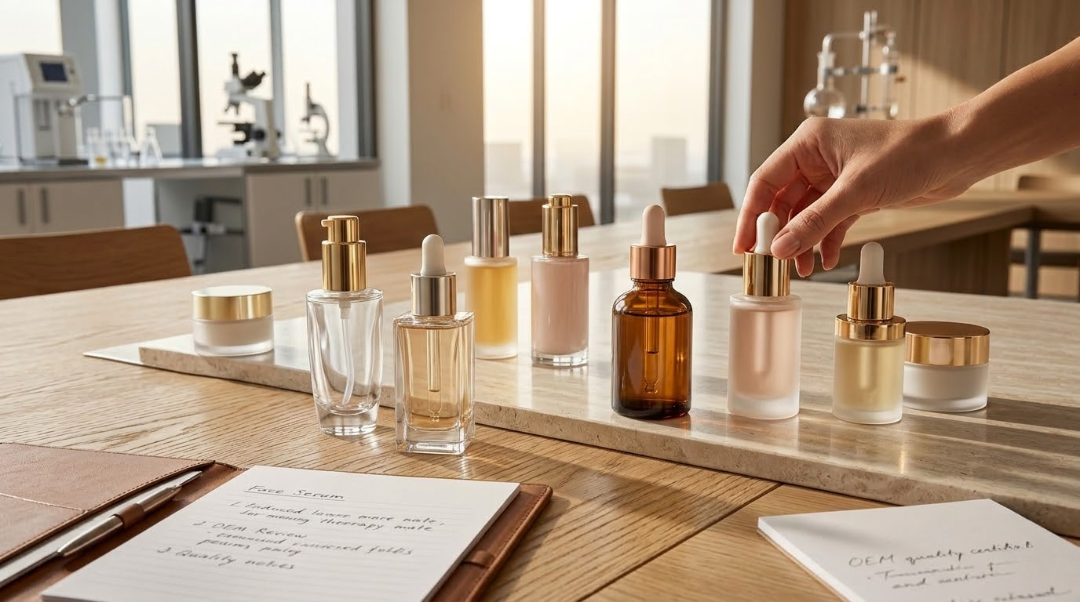
Just in the recently concluded 2025, the global beauty supply chain sent a strong signal: The crude era of simply private labeling off-the-shelf products for quick sales is over. We've witnessed giants like Musinsa no longer just settling for purchasing finished products; instead, they choose to collaborate with top-tier ODM companies like COSMAX to co-develop exclusive ingredients and new technology formulas . This reflects the anxiety and ambition permeating the entire market—when traffic costs are soaring, product strength becomes the brand's only true moat.
For brands aiming to break through in the highly competitive face serum, finding an OEM manufacturer that understands technology, is willing to co-create, and doesn't drop the ball is no longer just a "procurement activity" but a "strategic investment."
However, amidst thousands of factories clustered in places like Guangzhou and Ningbo, how do you see through the sales pitch and uncover the factory's true capabilities? This article will combine the latest industry data and practical experience to guide you through the complete logic of finding the right oem face serum manufacturer.
Redefining a "Good Factory": More Than Just Production, It's Your "Compliance Partner" and "Formula Think Tank"
When looking for a factory, brands often fixate on the numbers in the quotation or the initial feel of a sample on their skin. But in today's market, a qualified face serum OEM factory must possess the capability to help brands navigate through different lifecycle stages.
From "Toll Processing" to "Global Compliance" Leap
Your serum isn't just for sale in China anymore; it might reach Southeast Asia, or even Europe and America. This means the factory can't just show you certificates like GMPC and ISO 22716 . A truly forward-thinking brand will dig deeper: For EU CPNP registration, what ready-to-use toxicological reports can you provide? For US FDA requirements, does your preservative system align with local regulations?
A high-quality factory should act like your "external compliance brain." When they develop formulas, they inherently possess a global perspective. For instance, can the formula remain stable during shipping to the hot and humid Southeast Asian market? For the "clean beauty" focused欧美 market, can you provide complete raw material traceability data? If a factory only offers local certifications but hesitates when questioned by overseas regulatory authorities, such a partnership will inevitably become a cost black hole for the brand in the later stages .
R&D Isn't Just "Lab Self-Indulgence," It's Understanding "Skin Diversity"
The core of a serum lies in its "actives." But R&D strength isn't just about how many imported instruments are in the lab; it's about understanding real-world usage scenarios.
Take the South American market, for example. Consumers there face intense UV radiation and high humidity, requiring antioxidant serums that balance photo-stability with a lightweight, non-greasy texture . For anti-wrinkle serums targeting mature skin, it's not just about the concentration of Retinol, but also the encapsulation technology to minimize irritation.
An excellent OEM factory's R&D team should think like product managers. They not only possess a mature formula library for you to choose from but also understand how to perform active ingredient compounding and texture fine-tuning based on your target audience (e.g., oily, acne-prone skin for those in their 20s vs. dry, sensitive skin for those in their 40s). Factories that can adjust formulas considering climate, dietary habits, and even water quality are true "technical partners."
Hard Metric Breakdown: Using Data to Gauge a Factory's True Strength
During the initial screening, beyond touring the facility and checking certifications, the following operational data often provides a clearer picture of a factory's true service level.
Balancing Delivery Capability with Flexibility
For brands, stockouts mean lost revenue and momentum. Therefore, a factory's on-time delivery rate is a critical metric. Top-tier suppliers typically maintain this rate above 97% . Even more important is the flexibility regarding Minimum Order Quantities (MOQs) .
The serum category, involving specialized packaging (dropper bottles, ampoules) and配制 active ingredients, often leads many factories to set high MOQs. However, for growing brands, finding a factory that supports small-batch trials (e.g., 500 units or less per SKU) while guaranteeing quality consistent with larger production runs can significantly alleviate inventory pressure . A factory capable of supporting both 1-unit sampling and a smooth scale-up to 5000 units demonstrates strong supply chain flexibility.
The Management Granularity Behind Response Times
Don't underestimate the response speed of a sales representative or. Data suggests that top suppliers manage to keep inquiry response times within 3-4 hours . This speed isn't just about an individual salesperson's diligence; it reflects the standardization of the entire factory's project management workflow.
During subsequent collaboration, you should check if the factory provides a phased sampling process: concept confirmation, formula draft, trial batch, packaging compatibility testing. Is every step documented with records, images, and video updates? Factories that rely on casual WeChat voice messages for communication and lack formal project management significantly increase the risk of formula drift or packaging incompatibility during mass production .
Navigating the Collaboration Minefield: Intellectual Property and Cost Transparency
Serums are among the most technologically advanced skincare categories, and consequently, the most susceptible to抄袭. Choosing a factory is essentially choosing a level of business protection.
Formula Ownership: Does Your Bestseller Belong to You or the Factory?
This is the most sensitive and crucial issue. Many brands have painfully discovered that their successfully launched "Bifida Ferment Lysate Serum" suddenly appears on competitors' shelves, with similar packaging and a lower price.
Before signing any contract, you must clarify the intellectual property rights of the formula. Standard OEM involves the工厂 offering off-the-shelf formulas, limiting your choices to labels and fragrances. In contrast, deep ODM collaboration means the factory develops a formula based on your brief, and that specific formula—especially the combination of core ingredients—should be exclusively yours . Ensure the contract includes exclusivity clauses and request a detailed raw material list and MSDS (Material Safety Data Sheets) from the factory. This protects your consumers and acts as your brand's last line of defense.
Uncovering Hidden Costs: Don't Be Fooled by the Quotation
When faced with an attractive quotation, always probe further: Does this price include tax? Does it cover mold fees? Is the packaging standard or custom? Who pays for stability testing costs?
A major pain point for serums is packaging compatibility. The seal of the dropper, the effectiveness of an airless pump—these require extra testing. Some factories might to secure the order, then compensate with "formula adjustment fees," "rush order surcharges," or "sampling fees." A mature approach is to request an all-inclusive price from the factory, clearly defining the costs for any scope .
From 0 to 1: How to Co-Create a "Bestseller" Serum with a Factory
Once you've identified a potential partner, how do you efficiently transform your concept into a finished product on the shelf?
Step 1: The More Detailed Your Brief, The Closer the Product to Perfection
Don't just tell the factory, "I want an anti-aging serum." You need to provide:
-
User Persona: Who is it for? What are their spending habits and skin concerns?
-
Competitor Benchmarking: Which existing product's efficacy do you hope to match or surpass?
-
Core Selling Point: What's the key ingredient story? Is it an extension of "Vitamin C + Retinol" or an upgrade of "oil cleansing"?
-
Texture & Scent: Should it be, or rich like honey? Minimalist and fragrance-free, or with a therapeutic herbal scent?
The more precise your information, the better the factory's engineers can use their expertise, such as adjusting the ratio of polyols or selecting the emulsification system, to accurately replicate your desired texture .
Step 2: Sample Evaluation and Stress Testing
Don't make decisions based solely on applying the sample to the back of your hand a couple of times.
-
Extreme Environment Testing: Place samples in a 50°C oven and a freezer. Observe for separation or color change.
-
Packaging Compatibility Testing: Press the dropper 100 times continuously to check for smooth operation. Fill the packaging with the formula and let it sit for a week; check for any precipitation or corrosion of the packaging material.
-
Clinical Efficacy Testing: If feasible, recruit a small group of target users for a trial period. Gather真实 feedback based on actual use, rather than relying solely on the founder's subjective feeling.
Step 3: The Pilot Run – The Ultimate Test
Before committing to a mass production run of thousands of units, always strive for a pilot batch (e.g., 200-500 units). The purpose isn't necessarily to sell these, but to test the factory's mass production stability. What is the rate during filling? Is the date coding How efficient is the packaging process? These issues only during a small-scale pilot production. If a factory refuses to allow a pilot run, proceed with caution; it often indicates their quality control system cannot withstand scrutiny .
Final Thoughts
Searching for an oem face serum manufacturer is fundamentally about building trust. In the current landscape, information asymmetry is fading. Factories that once relied on information gaps are being淘汰, making way for manufacturers willing to invest deeply in R&D, embrace compliance, and grow alongside brands.
For brands, whether you're a fledgling indie label or an established company seeking a second growth curve, treat your factory as an extension of your R&D department and a partner to your marketing team. Scrutinize their R&D capabilities, question the source of every ingredient, and verify every certification.
When you approach a factory with a professional and discerning eye, what you gain is more than just a bottle of serum. You secure a powerful ally that can help your brand stand firm in the fierce market competition.
If you're ready to launch your serum project, why not take this guide and start the conversation with potential factories. A great partner can withstand the most detailed questioning.
Related_News
-

Sing Foo Participated in the 2025 Shanghai Beauty Expo
-
New GMP-Certified Production Line Officially Launched
-
New Product Series for Global Market
-
Skincare Manufacturer: How SINGFOO Masters the Art of Cosmetic Innovation
-
Cosmetic Manufacturer: SINGFOO – Where Vision Meets Precision in Beauty Manufacturing

SUBSCRIBE
IF YOU REQUIRE THE MOST SUITABLE PRODUCTS, FEEL FREE TO CONTACT US.
INQUIRY